
ESG in mineral supply is too often a document assembled after the fact, a report compiled once material has already moved, describing conditions nobody was measuring at the time. That is not evidence. It is a narrative written to fit a requirement.
Supplier-level emissions inputs, worker-welfare indicators, and site-level ESG signals belong inside operations, captured as evidence at the point of activity, the same discipline that makes compliance and provenance usable, applied to sustainability data.
Why after-the-fact ESG documents fail
An ESG document produced at export inherits every weakness of after-the-fact compliance. It cannot measure what was not observed, it cannot attribute what was not attributed, and it cannot withstand the review that responsible-sourcing and reporting regimes increasingly demand. The information it needs existed only for a moment, in the field, and was never captured.
You cannot report an ESG signal you never captured. Sustainability evidence has to be operational data, or it is just a story.
What captured-at-source ESG looks like
Treated as operational data, ESG signals are captured against the sites, operators, and activities they concern, at the time they occur.
- Emissions-relevant inputs recorded where the activity happens, attributable to a supplier and site.
- Worker-welfare and safety indicators captured as part of governed operations, not asserted afterward.
- Site-level ESG signals tied to approvals and readiness, so they carry the same integrity as compliance evidence.
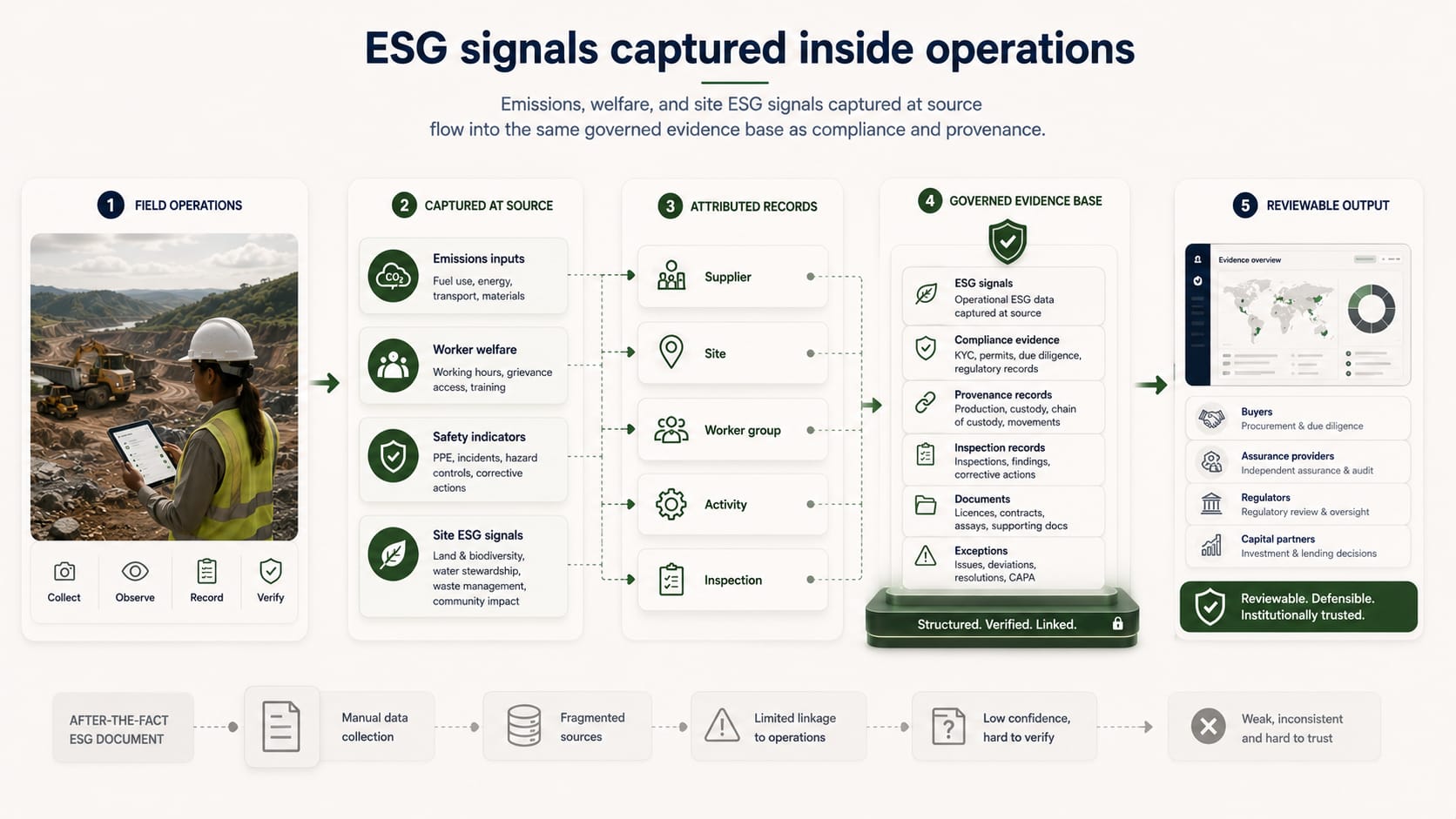
Figure 1. Emissions, welfare, and site ESG signals captured at source flow into the same governed evidence base as compliance and provenance.
The same governed evidence base
The advantage of capturing ESG as operational data is that it joins the same governed evidence base as everything else. It becomes reviewable in the same way, attaches to the same operators and sites, and feeds the same institutional outputs. Sustainability stops being a parallel reporting track and becomes part of the record institutions already assess.
Axalio structures and surfaces ESG and emissions evidence. It does not certify ESG performance, replace assurance providers, or guarantee compliance with any reporting regime.