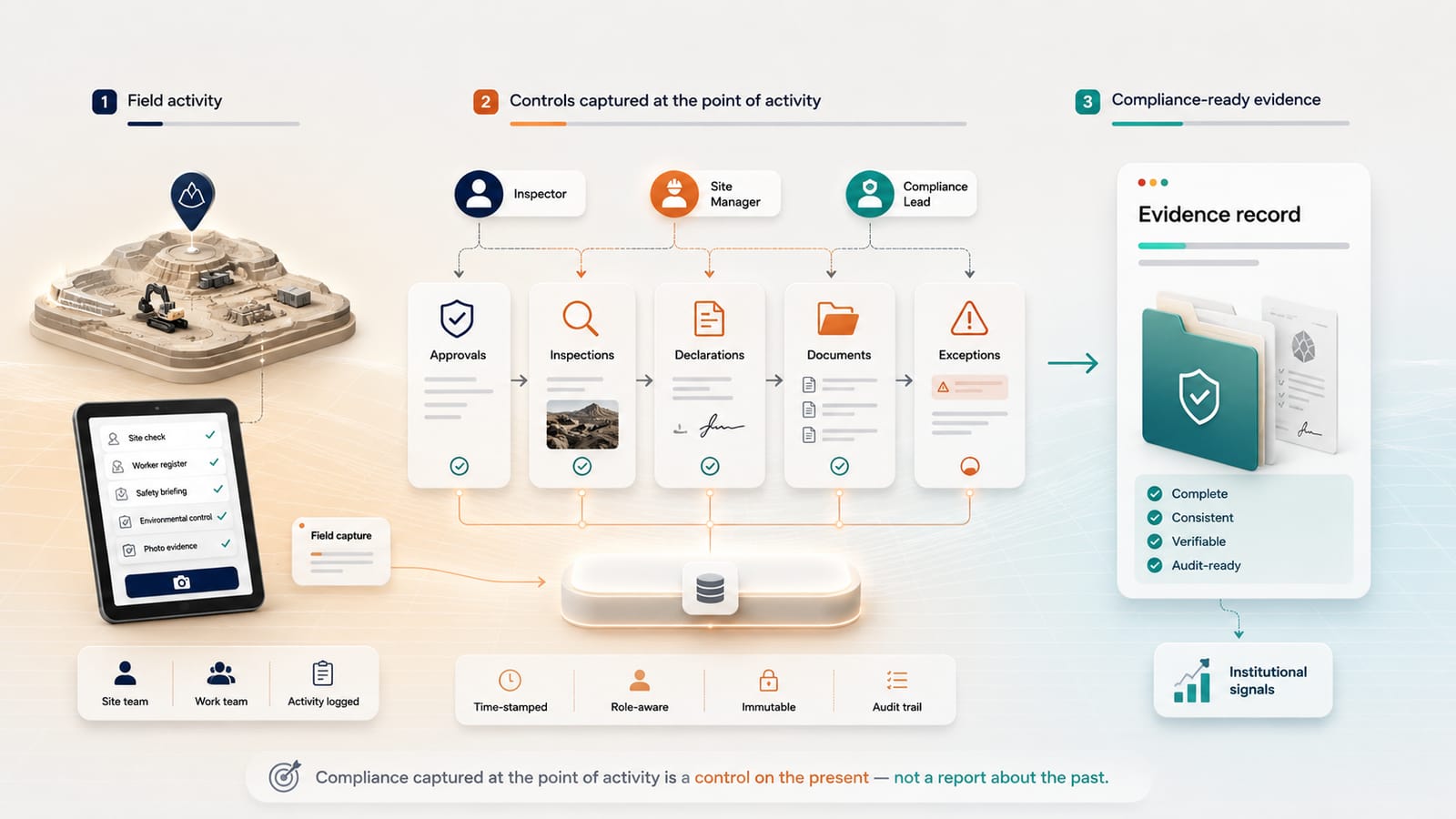
Most compliance failures are not failures of intent. They are failures of timing. The controls existed, the approvals were required, the inspections were meant to happen, but the evidence was assembled weeks later, at export, from memory and scattered paperwork. By then the moment that mattered has passed.
Compliance is treated, too often, as a reporting exercise: a pack compiled at the end of a process to satisfy a buyer, a regulator, or an auditor. That framing quietly concedes the point. If compliance is something you produce afterward, then for the entire period when the work was actually being done, nobody was being held to it.
Compliance by design inverts that. It treats controls, approvals, inspections, and declarations as part of the field workflow itself, captured where and when the activity occurs, by the person accountable for it. The output is not a reconstructed narrative. It is a structured record generated at source.
Why export-stage compliance is already too late
By the time a lot reaches export, its history is fixed. Whatever governance did or did not happen at the site, on the shift, at the point of handover, is now a matter of record only if someone recorded it. Reconstructing that history after the fact has three predictable problems.
- Gaps become permanent. A missed inspection or an unapproved movement cannot be back-filled honestly; it can only be papered over or disclosed.
- Evidence loses its authority. A declaration signed at export about an event three weeks ago carries less weight than one captured at the moment the event happened.
- Accountability blurs. When records are assembled centrally at the end, it is no longer clear who was responsible for what, when.
None of this is solved by a better spreadsheet or a stricter export checklist. It is solved by moving the point of capture upstream, to where the accountable activity takes place.
Compliance you assemble at export is a description of the past. Compliance you capture in the field is a control on the present.
What field-level controls actually look like
Structuring compliance into field workflows does not mean adding bureaucracy to the work. It means making the controls that already govern the work legible and reviewable as they are performed. In practice that is a small set of connected objects.
Approvals, before movement
An approval is a gate, not a form. When an operator, site, or lot requires sign-off before it can proceed, the gate is enforced in the workflow and the approval, who granted it, on what basis, when, is captured as evidence. The control and its record are the same action.
Inspections and declarations, at the point of activity
Inspections are logged where they happen, against the site or lot they concern, by the role carrying them out. Declarations are captured the same way. Documents are attached to the objects they describe rather than filed in a separate system that has to be reconciled later.
Risk flags, raised and resolved in place
When something is wrong, an exception, a red flag, a corrective action, it is raised against the relevant object and carried until it is resolved. The unresolved state is visible. Nothing is quietly dropped between the field and the head office.
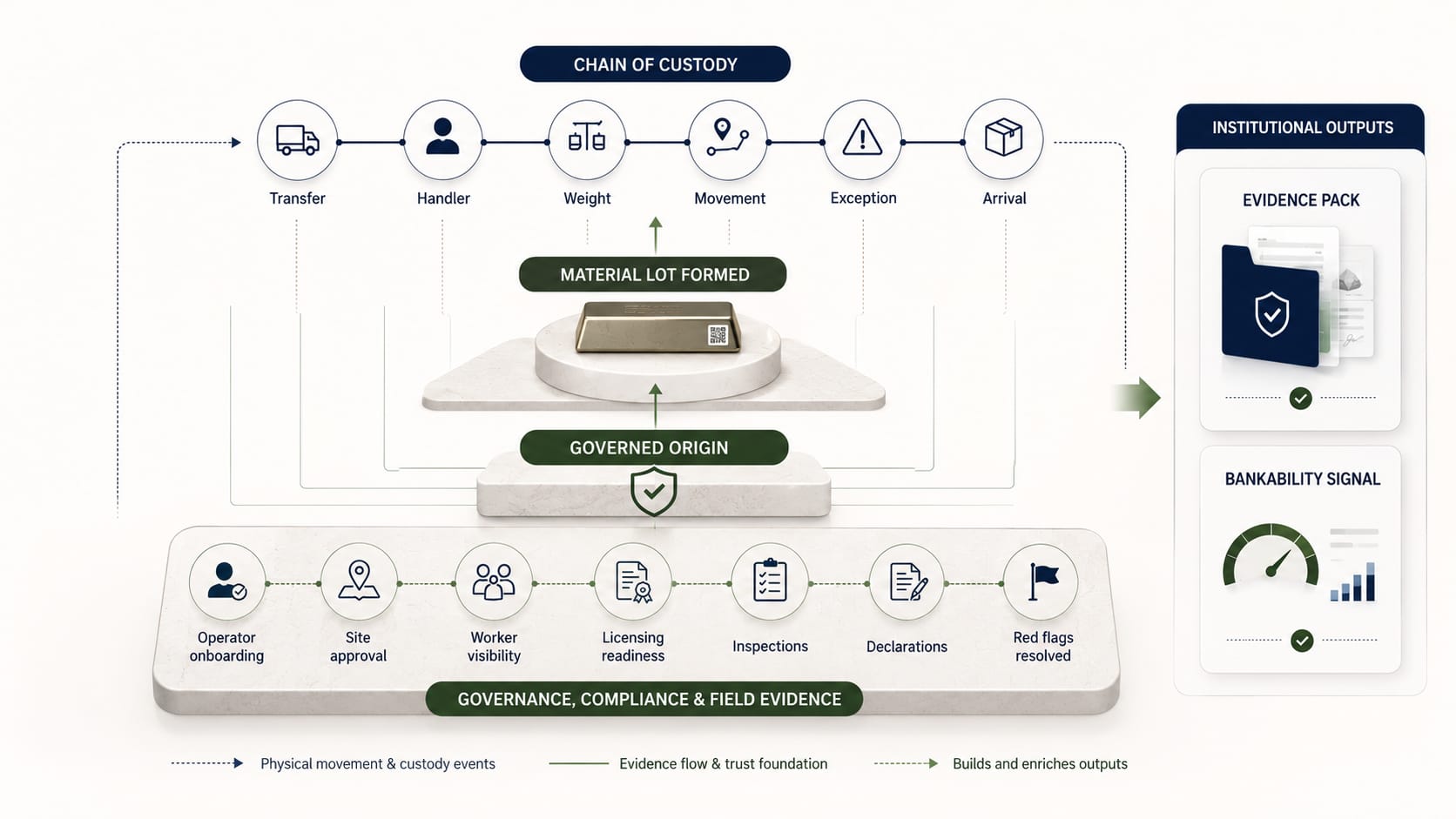
Figure 1. Governance, compliance, and field evidence, captured at the point of activity, form the governed origin a chain of custody rests on, and feed the institutional outputs a counterparty reviews.
Role-aware, so accountability is unambiguous
A control is only meaningful if it is clear who owns it. Field-level compliance is role-aware: an inspector sees inspection tasks, a site manager sees approvals and readiness, a compliance lead sees exceptions and evidence. Each action is attributed to the role that performed it, which is what makes the resulting record auditable rather than merely complete.
This is also what keeps the workflow humane. People are asked to capture the evidence relevant to their own accountable work, at the moment they do it, not to compile a compliance narrative for the whole operation at the end of the month.
What this earns downstream
Evidence captured at the point of activity is what makes everything after it credible. A chain of custody built on governed, field-captured records inherits their integrity. A compliance pack drawn from structured evidence can be reviewed rather than taken on trust. And the same records feed the institutional outputs, evidence packs and structured signals, that buyers, regulators, and capital partners actually assess.
Axalio's role here is deliberately bounded. It is the system of record and the coordination layer: it captures, structures, verifies, and surfaces the evidence. Inspectors, auditors, regulators, and assurance providers continue to do their own work. Axalio does not replace them, and it does not decide whether an operation is compliant. It makes the evidence usable so that the people who make those judgements can make them on something solid.
Axalio structures and surfaces compliance evidence. It does not certify compliance, replace regulators, inspectors, or auditors, or guarantee export approval or buyer acceptance.