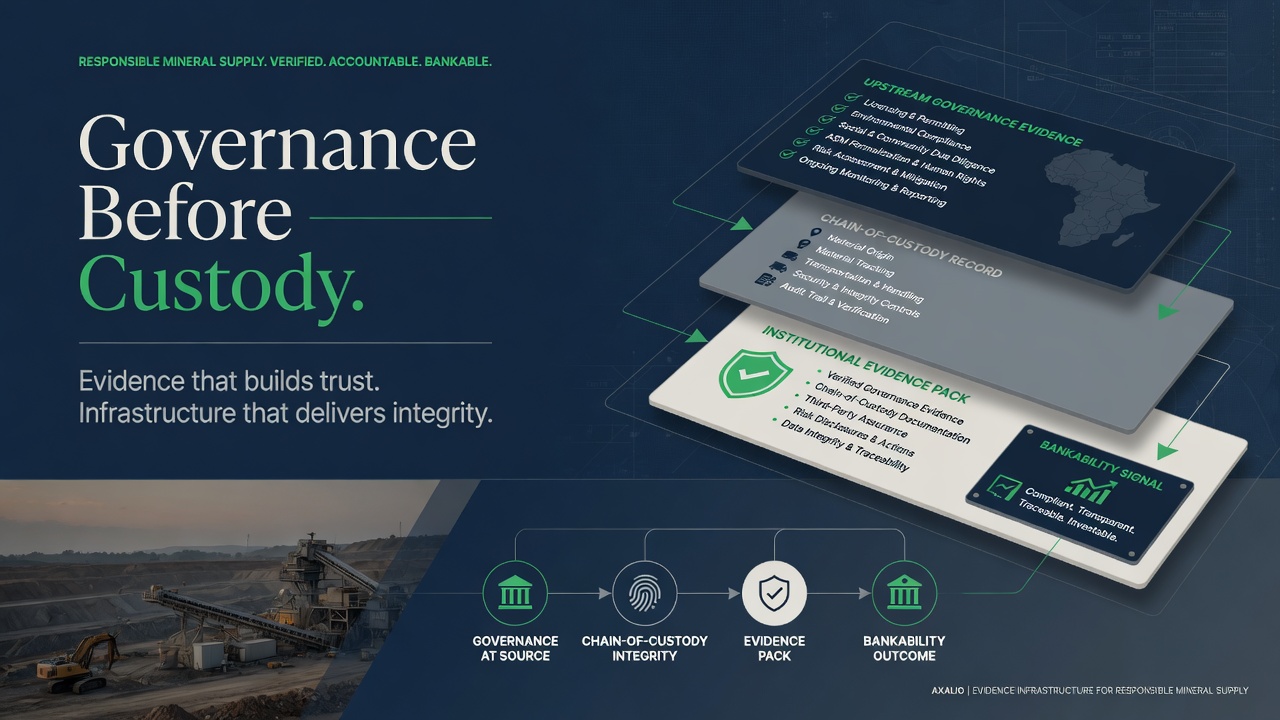
A documented chain of custody is a powerful thing. Done well, it gives a lot a signed, append-only record of every transfer, every handler, and every exception from origin onward. For a buyer trying to understand where material has been, it is close to indispensable.
It also answers a narrower question than most institutions assume. A custody record describes movement. It tells you what happened to a lot once it existed as a lot. It is largely silent on everything that happened before, at the source, where the conditions that make supply trustworthy are actually set.
The question a chain of custody answers
Movement is the easy part to document, because by the time material is moving there is something tangible to attach a record to. A lot is formed. A weight is logged. A handler signs. Each event appends to the record, and the record holds. This is real and useful, and it is what most traceability systems are built to do.
The limitation is that the record inherits the integrity of its starting point. If the first entry describes a lot whose origin was never governed, the chain faithfully carries an ungoverned origin forward, in perfect order, to the buyer's books.
The question it leaves open
The harder questions sit upstream of the first custody event, and they are the ones a serious counterparty needs answered. Was the site approved. Was the operator verified. Were workers registered and visible. Was the operation licensed and ready. Were inspections carried out, declarations captured, and red flags addressed before any material entered the chain.
None of that is visible in a record of movement, because none of it is a movement. It is governance. And it is exactly the part that separates supply an institution can underwrite from supply it cannot.
Governance earns trust. Trust earns bankability. A record of movement, on its own, earns neither.
Where the evidence has to start
If the gap is upstream, the evidence has to start upstream too, captured at the point of activity rather than reconstructed afterward. In practice that means structuring the things a custody record assumes but never proves:
- Operator and cooperative onboarding, so participants are known entities, not anonymous inputs.
- Site approval and readiness, so origin is a governed place, not a coordinate.
- Worker visibility, so labor and safety controls are observable, not asserted.
- Licensing and compliance readiness, tied to operational legitimacy and responsible sourcing.
- Inspections, declarations, and red flag management, captured before material enters the chain.
Captured this way, governance is not a certificate filed once and forgotten. It is structured evidence, generated where the work happens, that gives every downstream custody event something real to stand on.
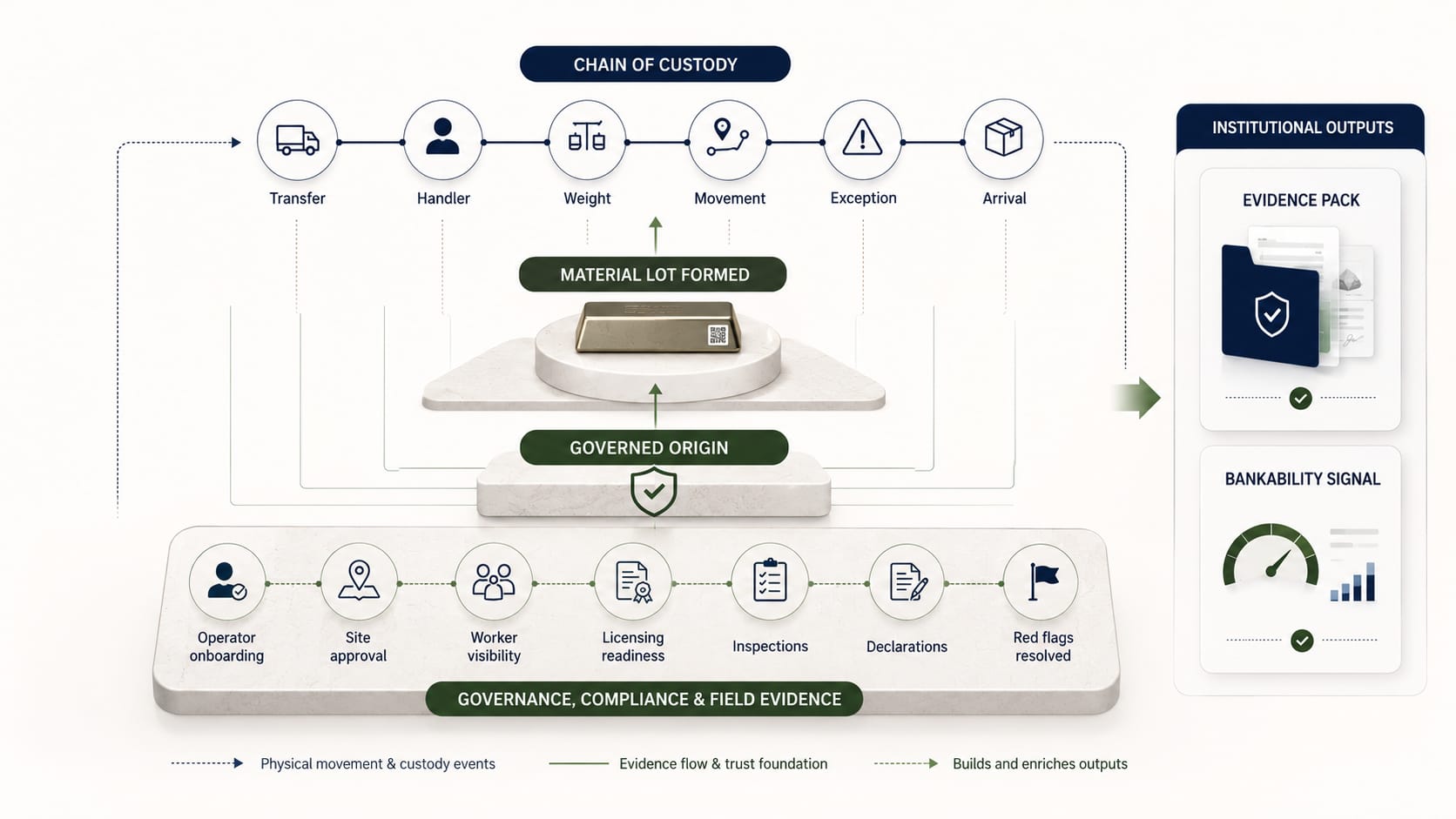
Figure 1. Governance, compliance, and field evidence sit beneath the chain of custody, not after it, feeding the institutional outputs a counterparty reviews.
From governed origin to underwriting grade signal
Governance is the wedge, but it is not the whole argument. The reason an institution cares that origin is governed is that governed origin is what makes supply assessable, financeable, and tradeable. The site has to carry the reader all the way to that payoff, not leave them at visibility.
This is the work the evidence engine does. Governed, verified field reality is converted into the language institutions actually use, so an ecosystem, operator, or supply stream can be assessed for diligence, credit, and capital.
The architectural posture matters here. Axalio is the system of record and the coordination layer. It captures, structures, verifies, and surfaces. The physical and assurance work stays with the operators, cooperatives, inspectors, refiners, and assurance providers who do it. Axalio orchestrates. It does not operate.
Why this is the order that holds
Most systems begin where material starts moving, because that is where documentation is easiest. Axalio begins earlier, at governance, formalization, compliance, and field level evidence, and carries that evidence forward into signals capital can use. The sequence is deliberate: governance and formalization, then compliance and evidence, then production and provenance, then a documented chain of custody, then reporting and trade readiness, and only then bankability, where governance is already strong.
Read in that order, a chain of custody stops being the foundation and becomes what it actually is: one reliable layer in a structure that was governed from the ground up. That is the version of provenance an institution can stand behind.
The Bankability Score is a structured signal intended to support assessment. It is not a rating, a guarantee, or a promise of finance. Axalio is a system of record and coordination layer; it does not operate mines or certify minerals.