
Institutions do not finance stories, and they do not finance dashboards. They finance things they can assess. The gap in responsible mineral supply has rarely been a shortage of activity or of good intentions, it has been the absence of a structured, reviewable signal that lets a capital partner form a view. The Bankability Score exists to be that signal, and to be honest about what a signal is.
It is a decision-support output: a composite, generated from governed evidence, that helps an investor, a development finance institution, a buyer, or a trade financier decide where to look harder. It is not a rating, not a guarantee, and not a promise of finance. Holding that line is not a legal footnote, it is what makes the score worth anything.
Why institutions need a structured signal
A diligence team faces a practical problem: many possible counterparties, limited time, and no consistent way to compare them. One operator sends a polished deck; another sends nothing; a third sends a shoebox of scanned documents. There is no shared basis for a first-pass judgement, so serious capital simply stays away from the whole category.
A structured signal changes the economics of that first pass. If governed evidence can be expressed in a consistent, composite form, a diligence team can triage: engage here, ask questions there, decline for now. The score does not make the decision. It makes the decision approachable.
What the score is built to assess
The Bankability Score is composite because bankability is composite. No single dimension carries it. FORGE draws on the governed evidence already captured in the operating modules across a small number of assessable axes.
- Finance, the presence and coherence of the records a financier would expect to review.
- Operations, whether the operation runs as a governed, legible activity rather than an opaque one.
- Risk, exceptions, red flags, and how they are managed, not merely whether they exist.
- Governance, formalization, approvals, and the readiness of operators and sites.
- Evidence, the depth and reviewability of the underlying records themselves.
Each axis is grounded in evidence captured at source, which is why the composite means something. A score assembled from self-reported summaries would be a restatement of the pitch. A score assembled from governed field evidence is a reading of reality.
The Bankability Score is a reading of governed evidence, not a verdict on it. It tells an institution where to look, not what to conclude.
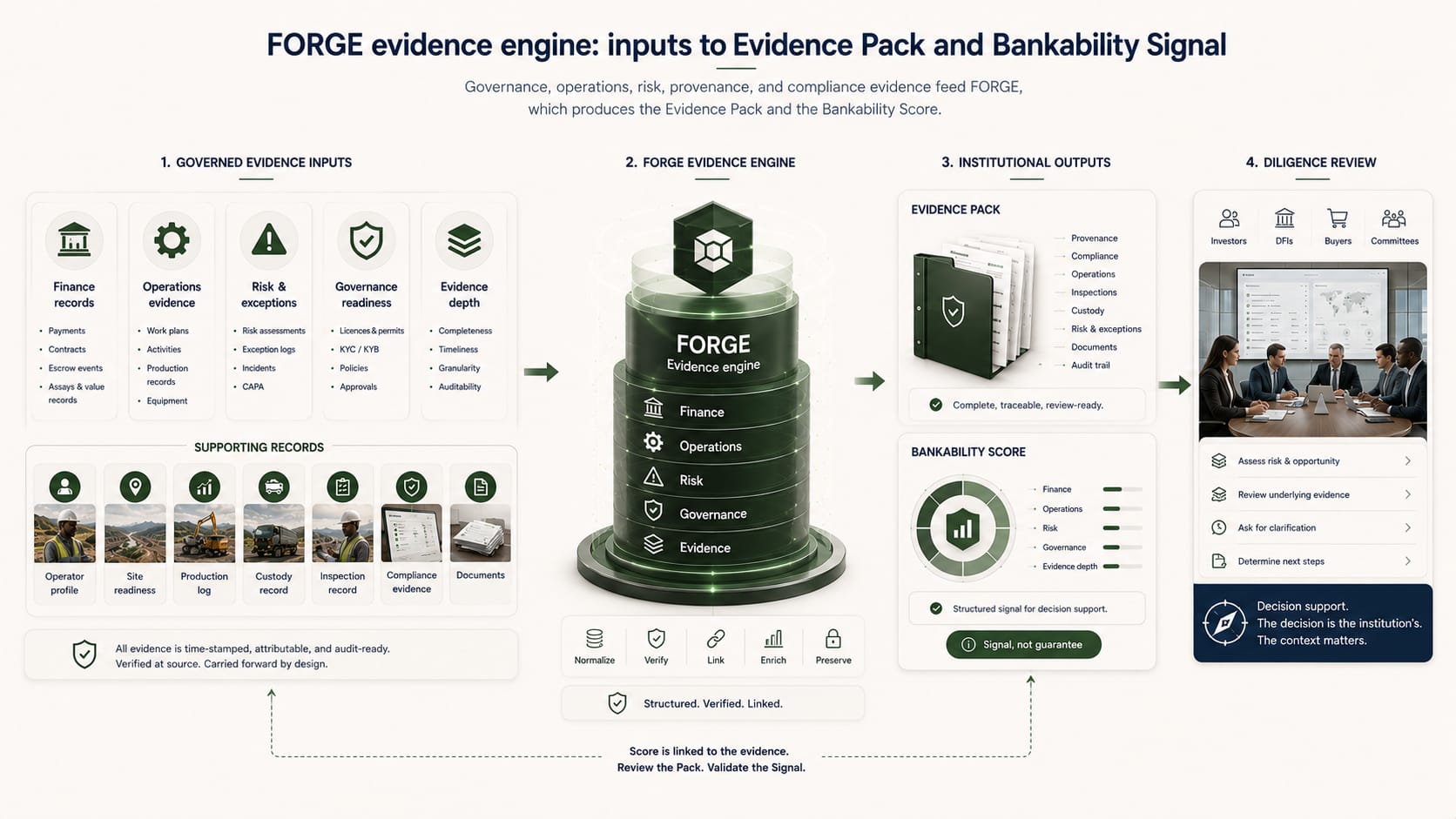
Figure 1. Governance, operations, risk, provenance, and compliance evidence feed FORGE, which produces the Evidence Pack and the Bankability Score.
What the score does not claim
Precision about the score's limits is part of its design. The score does not certify the operation, does not guarantee that finance will follow, does not guarantee buyer acceptance or export approval, and is not a regulated investment rating. It does not replace the diligence a financier must still perform; it informs and accelerates it.
A high score is an invitation to look closely with confidence that the evidence will hold up. A low score is not a verdict on an operation's worth, it is a statement that the evidence, today, does not yet support institutional assessment. In both cases the score points toward the underlying records, which is where any real decision is made.
How evidence packs carry the diligence
The score is the headline; the Evidence Pack is the substance behind it. Where the score compresses governed reality into a comparable signal, the pack expands it back out into the structured records a diligence team actually reviews, provenance, compliance, governance, and risk evidence, assembled coherently rather than requested piecemeal. The score gets an institution to the table. The pack is what it reads once seated.
The Bankability Score is a structured signal intended to support assessment. It is not a rating, a guarantee, or a promise of finance, and it is not a regulated investment rating. Axalio does not guarantee financing, buyer acceptance, or export approval.