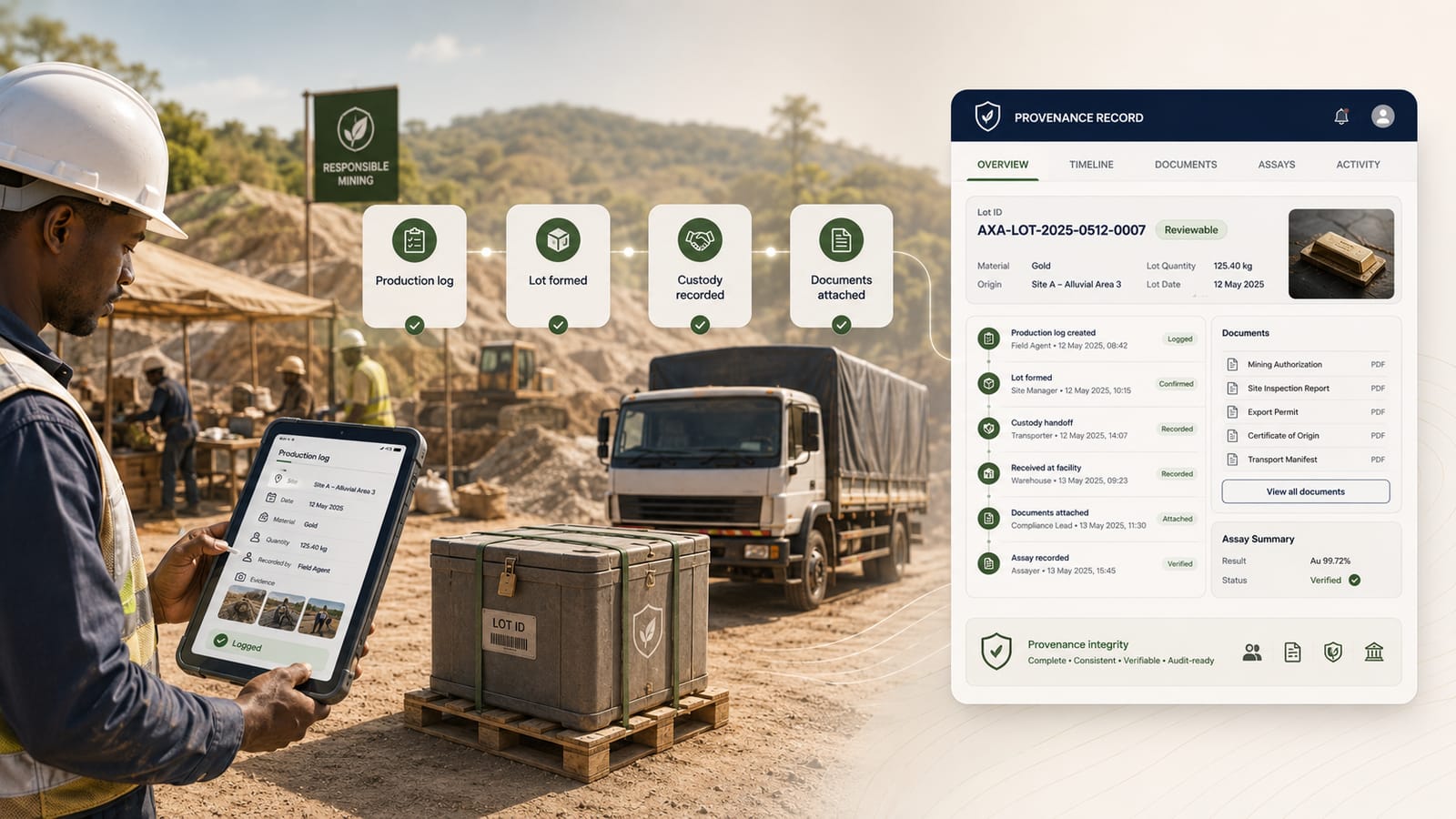
Provenance has become a marketing word. It is used to mean a story about where something came from, a photograph of a mine, a name, a claim of origin. That version of provenance is not useless, but it is not something a buyer, a refiner, or a regulator can rely on. It cannot be reviewed, only believed.
Usable provenance is different. It is a documented record that links what was produced, how it became a lot, who held it at each step, and what documents support each of those events, assembled so that a counterparty can inspect the connections rather than trust the summary.
An origin claim is not a provenance record
An origin claim asserts a fact: this material came from here. A provenance record demonstrates it, by carrying the evidence that would let someone check. The distinction is the whole game. Institutions do not underwrite claims; they review records.
A record that can be used has three properties a claim never has. It is linked, each event references the objects it concerns. It is supported, documents, assays, and approvals are attached to the events they describe. And it is reviewable, a third party can follow it end to end and see where it holds and where it is thin.
Provenance is not a story you tell about a lot. It is a record a stranger can check without asking you to vouch for it.
The production log is the first usable layer
Provenance does not begin when material starts moving. It begins earlier, at production, where the first genuine evidence exists. A production log, what was recovered, where, on which shift, under whose responsibility, is the foundation everything else attaches to. Skip it, and the chain begins with an assertion instead of a record.
Lot formation, made explicit
Material becomes commercially legible when it becomes a lot. Lot formation is the moment scattered production is aggregated into a unit that can be weighed, described, and moved. When that moment is captured, what production went into the lot, when, and on whose authority, the lot carries its own origin rather than acquiring one by assumption.
Custody events, handlers, and exceptions
From lot formation onward, every transfer is an event: a handler, a time, a place, a change of responsibility. Exceptions, a discrepancy in weight, a missing document, a deviation from the expected route, are recorded against the lot rather than smoothed over. A clean chain with no exceptions ever raised is not more trustworthy; it is less.
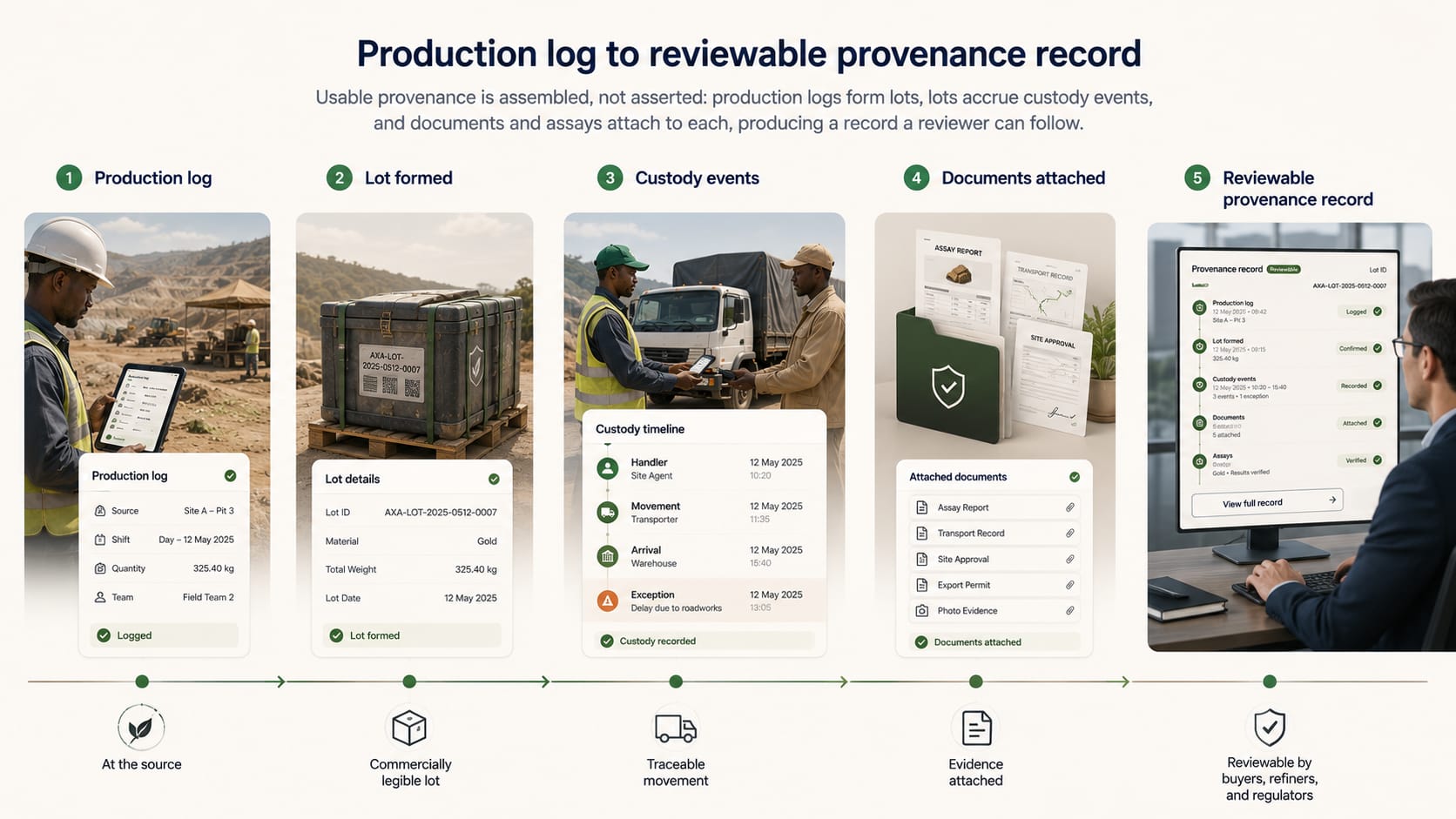
Figure 1. Usable provenance is assembled, not asserted: production logs form lots, lots accrue custody events, and documents and assays attach to each, producing a record a reviewer can follow.
What makes provenance usable to a buyer or refiner
A refiner's due-diligence team, a buyer's compliance function, and a regulator reviewing a shipment are all asking the same underlying question: can I rely on this without taking your word for it. Provenance is usable when the answer is demonstrably yes.
- Every claim resolves to an event, and every event resolves to a record with an owner and a time.
- Supporting documents, assays, approvals, transport records, are attached to the events they concern, not stored separately.
- Exceptions are visible and their resolution is traceable, so the reviewer sees judgement, not just a clean surface.
- The whole record can be exported as a coherent evidence pack, not reassembled on request.
Provenance is one layer, not the foundation
It is tempting to treat chain of custody as the base of trust. It is not. A custody record inherits the integrity of the origin it starts from. Provenance that can be used sits on top of governed origin, formalized operators, approved sites, captured compliance, and carries that governance forward into a record institutions can review. Custody is essential, but it is a layer, not the ground.
Axalio structures and surfaces provenance records. It does not certify minerals, replace assay laboratories or assurance providers, or guarantee buyer acceptance or export approval.